From Chaos to Clarity: Redesigning Portugal's Residence Renewal Experience
Timeline: 8 Weeks
Project Type: Service Design
Role: Service Designer
CONTEXT
At the end of 2023, the Portuguese government changed the immigration authority agency that managed the residence authorizations for foreigners, from the old agency SEF, to a new agency AIMA.
THE PROBLEM
Once the change took effect, foreign residents faced a service breakdown: unclear guidance, inaccessible support channels, and wait times stretching to 11 months with zero status updates. The result? Users anxiously turned to Reddit and Facebook groups instead of official channels, unable to get answers to basic questions about their residence renewals and unable to leave Portugal for fear of not being able to return.
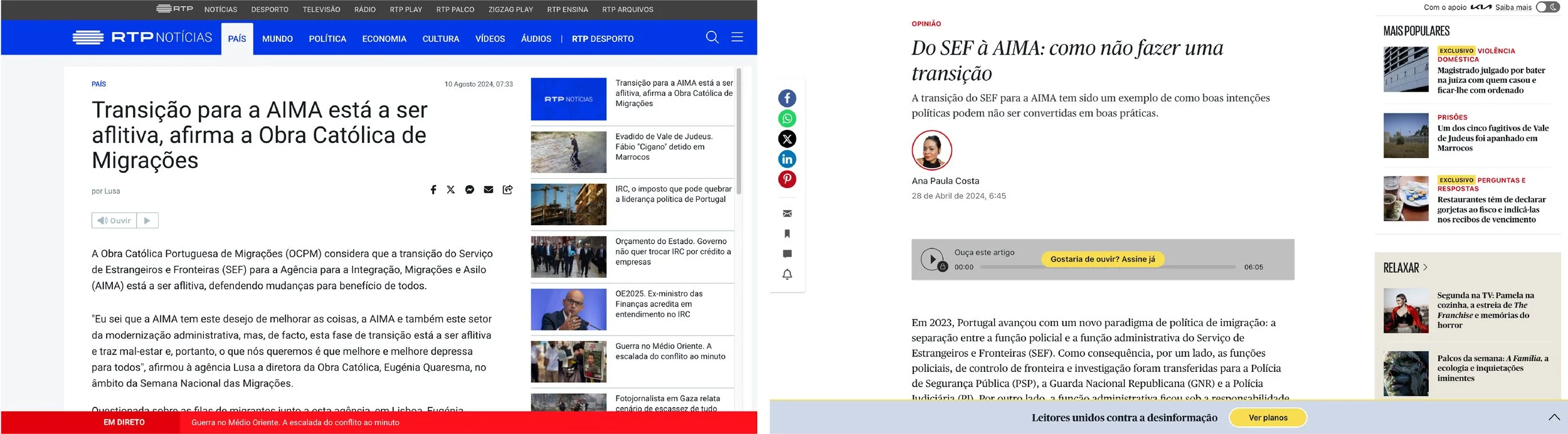
News articles highlighting issues faced during the AIMA transition - Left: "The transition to AIMA is proving difficult, says the Catholic Migration Service" - RTP News; Right: "From SEF to AIMA: how not to manage a transition" - Público.
MY APPROACH
Witnessing friends and family struggle with the AIMA renewal process—along with countless other users as was widely reported in local media—I conducted independent research to validate whether these issues were systemic. Through interviews with 10 foreign residents, I aimed to map the complete renewal experience, identify consistent pain points, and design solutions that would give users greater transparency and control.
IMPACT AT A GLANCE
Reduced need for users to contact AIMA via phone/email for information;
Fewer in-person appointments needed purely for status checks;
Decreased user reliance on unofficial information sources;
Increased user confidence and satisfaction throughout the process.
This is a personal project based solely on user research, without access to AIMA's internal operations.
Research Insights
To understand the renewal experience, I interviewed 10 foreign residents who had recently completed the AIMA renewal process, mapping their end-to-end journey from information seeking to document receipt. Three critical pain points emerged, all stemming from severe information gaps and lack of transparency:
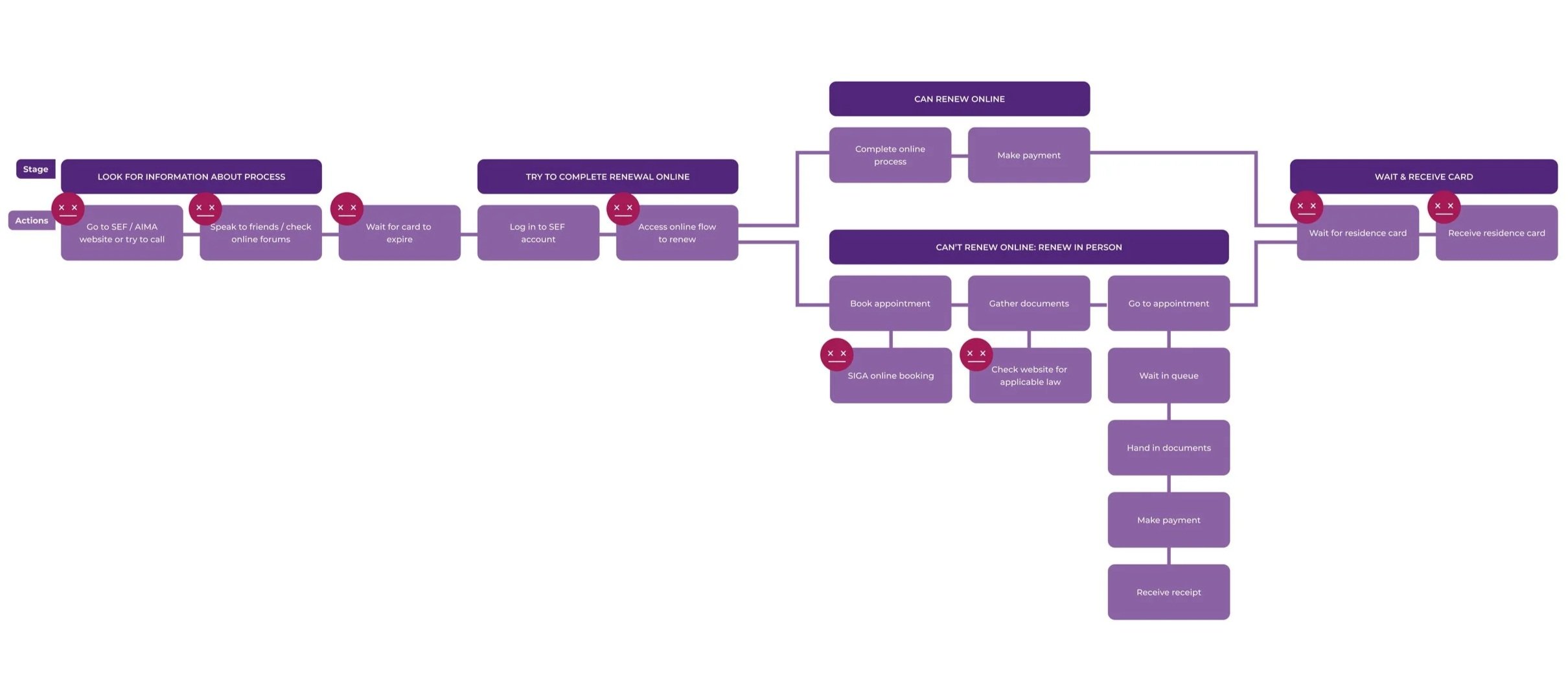
Customer journey map - red dots identify where users experienced the most frustration during the renewal process
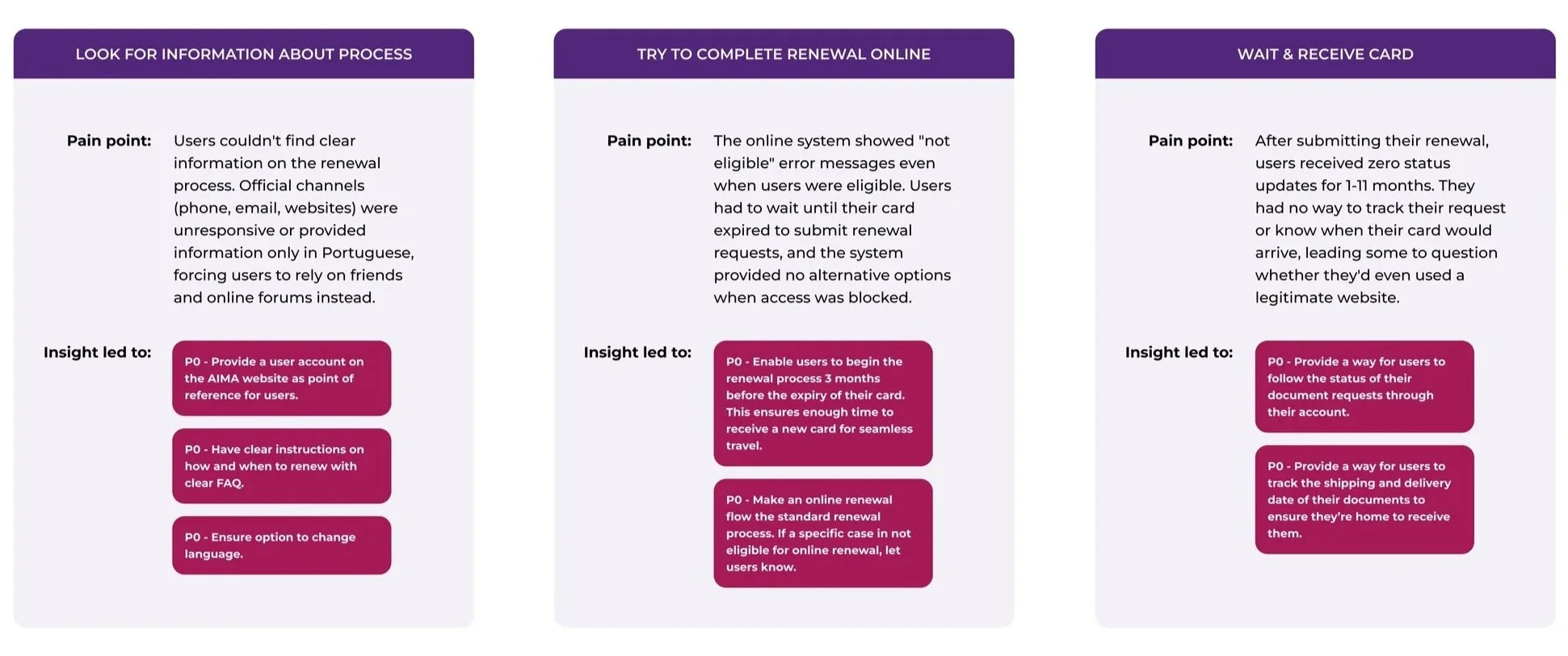
3 of the biggest pain points in the customer journey and how these directly impacted the opportunities I identified
Inaccessible official communication: 100% of interviewees relied on friend networks, forums, and news rather than AIMA directly—phone lines went unanswered, emails received no response, and website information was limited, unclear, and mostly in Portuguese only. When users did reach staff, information varied depending on who they spoke to.
Unclear renewal submission process: Users spent weeks or months attempting to submit requests on a system that showed ineligibility errors (often inaccurately), after their cards had already expired. Those unable to access the online system found the appointment booking process required checking one district at a time with no consolidated availability view.
No status updates after submission: Users received only a "Completed" status with no further communication until cards arrived unannounced 1-11 months later. This information vacuum led one user to question whether they'd used a legitimate website, while another hired a lawyer after 10 months without any status updates from AIMA.
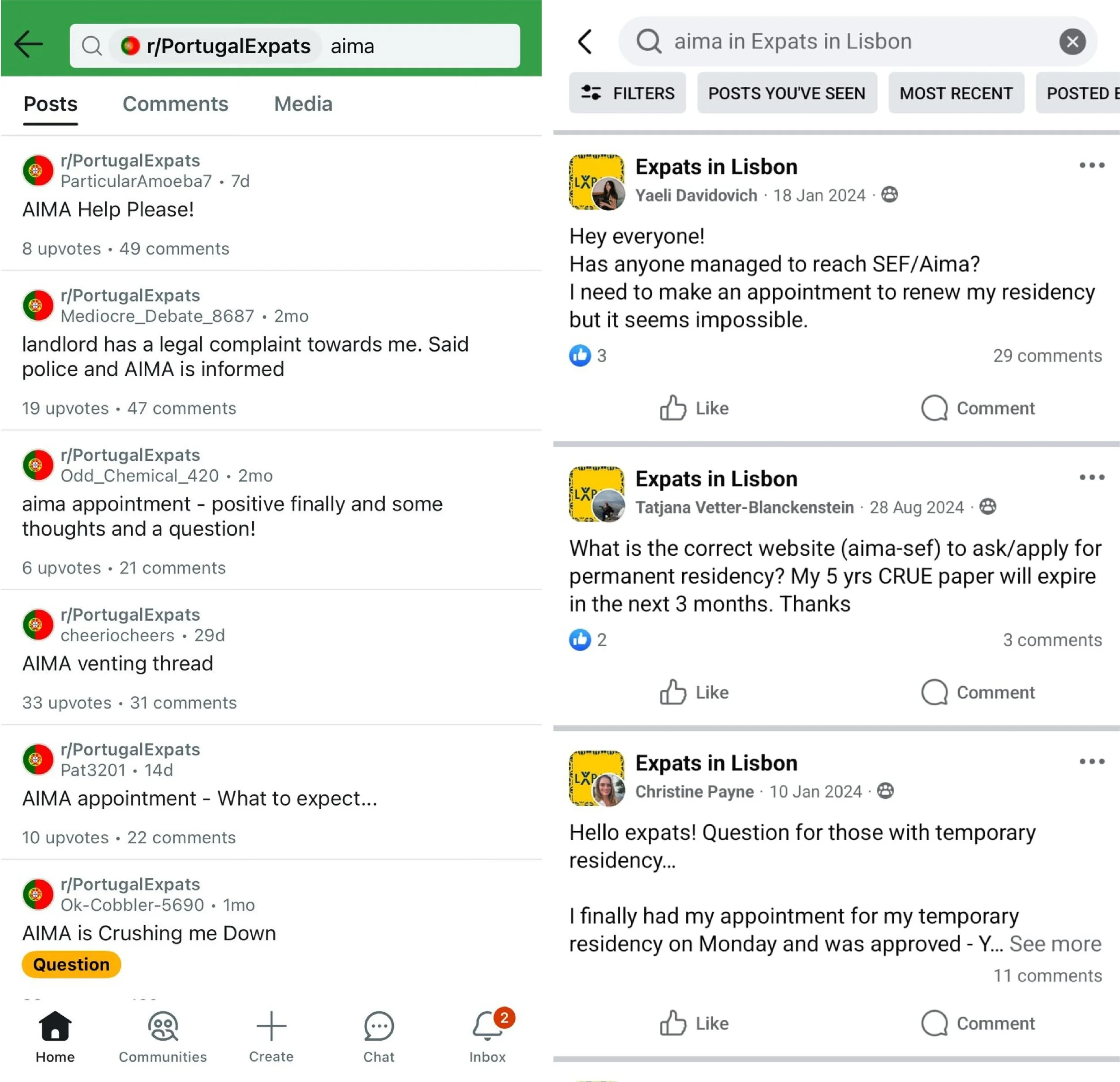
An example of a subreddit and a Facebook group where AIMA is a frequent topic
Solutions
To address these pain points, I prioritized solutions that would maximize information transparency and user control, sequencing features from foundational (P0) to enhanced services (P1) to future enhancements (P2). This phasing ensured that most users could complete their renewal entirely through the new app without contacting AIMA, resolving the most critical gaps in information access and process visibility.
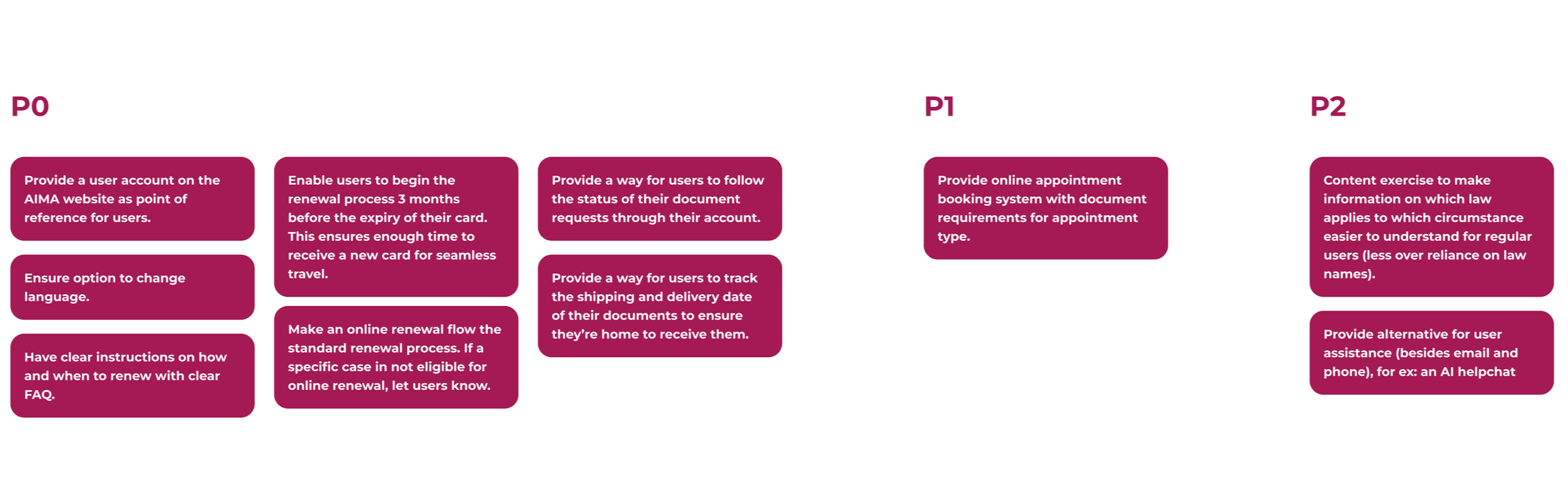
Feature prioritization focused on information transparency and user control
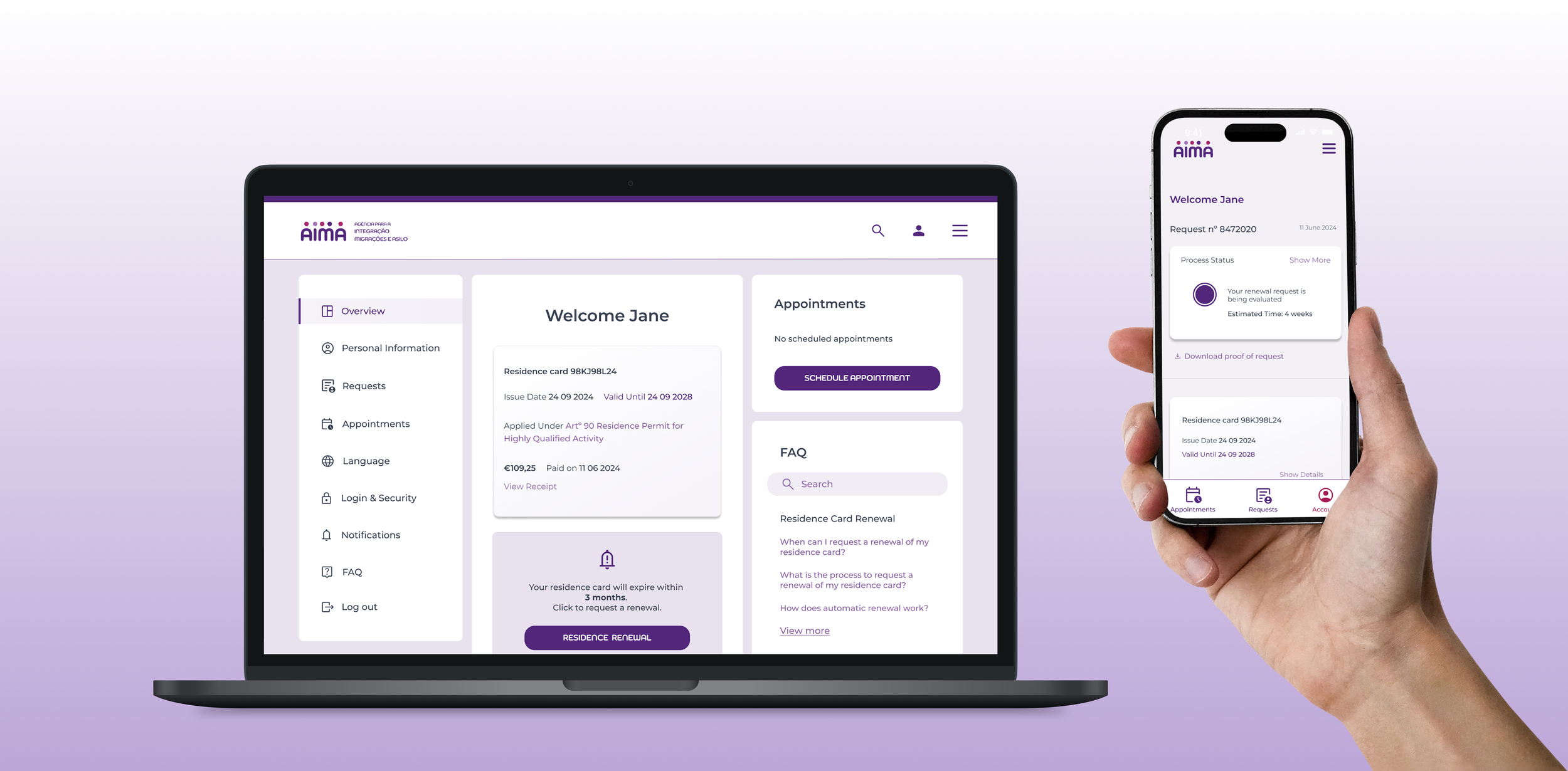
This approach resulted in an integrated web and mobile app with user accounts at the core:
Clear information and guidance throughout the process: Multilingual instructions, FAQ, and timeline expectations accessible from a single dashboard, eliminating reliance on unofficial channels
Transparent and accessible renewal flow: Renewal initiation 3 months before card expiry with clear eligibility status. If a case isn't eligible for online renewal, users receive explanation and alternative appointment booking options
Real-time visibility and control: Status tracking for renewal requests and delivery notifications through the user account, ending the 1-11 month information vacuum
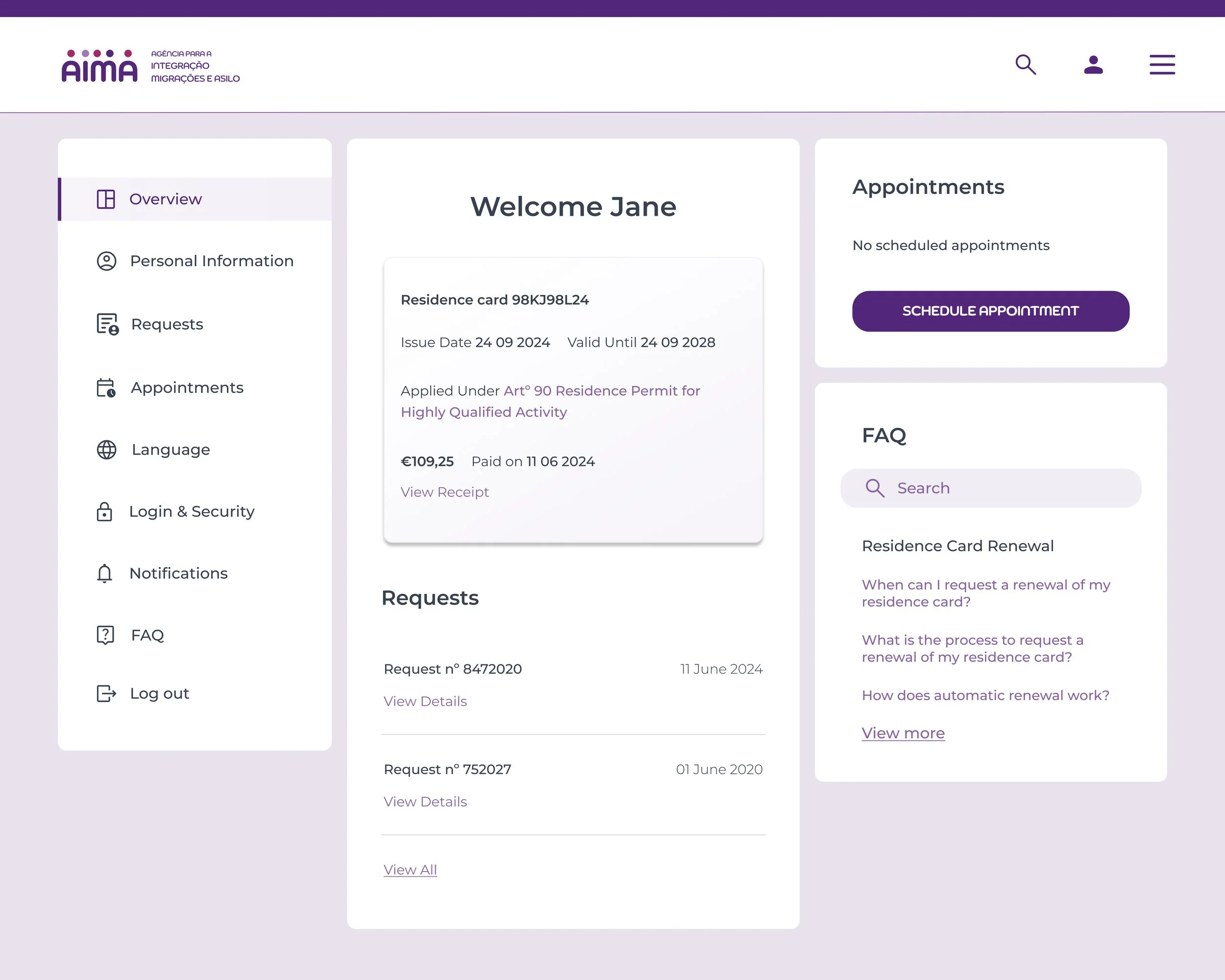
The overview is the first page you see after logging in. From here you can view your current residence card information, view previous requests, access FAQ about the residence renewal process and schedule appointments.
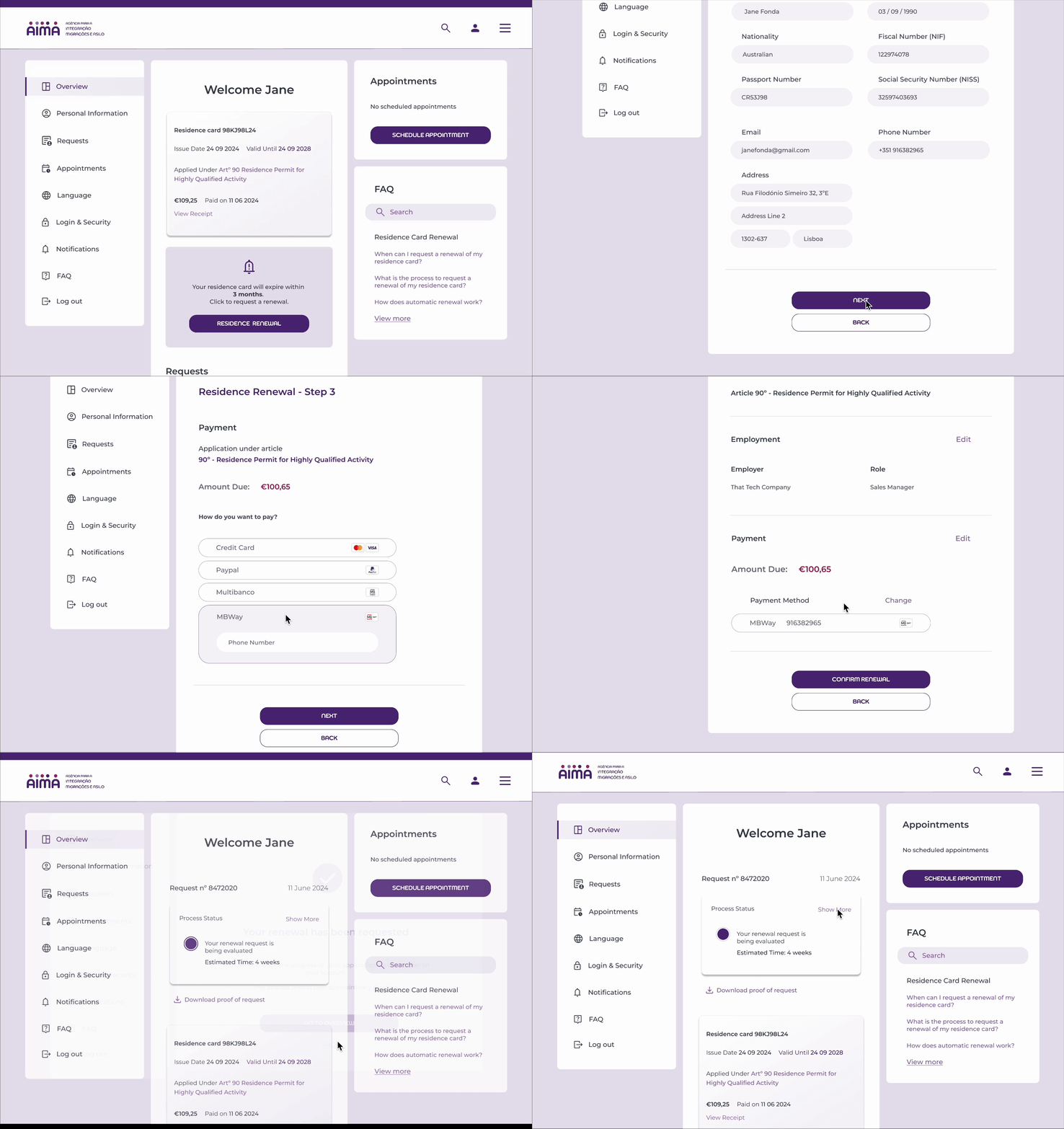
Online renewal flow giving users more flexibility when requesting renewals of their residence cards. Users would receive a notification 3 months before their card expired and a CTA on the user overview and requests page to begin the online process.
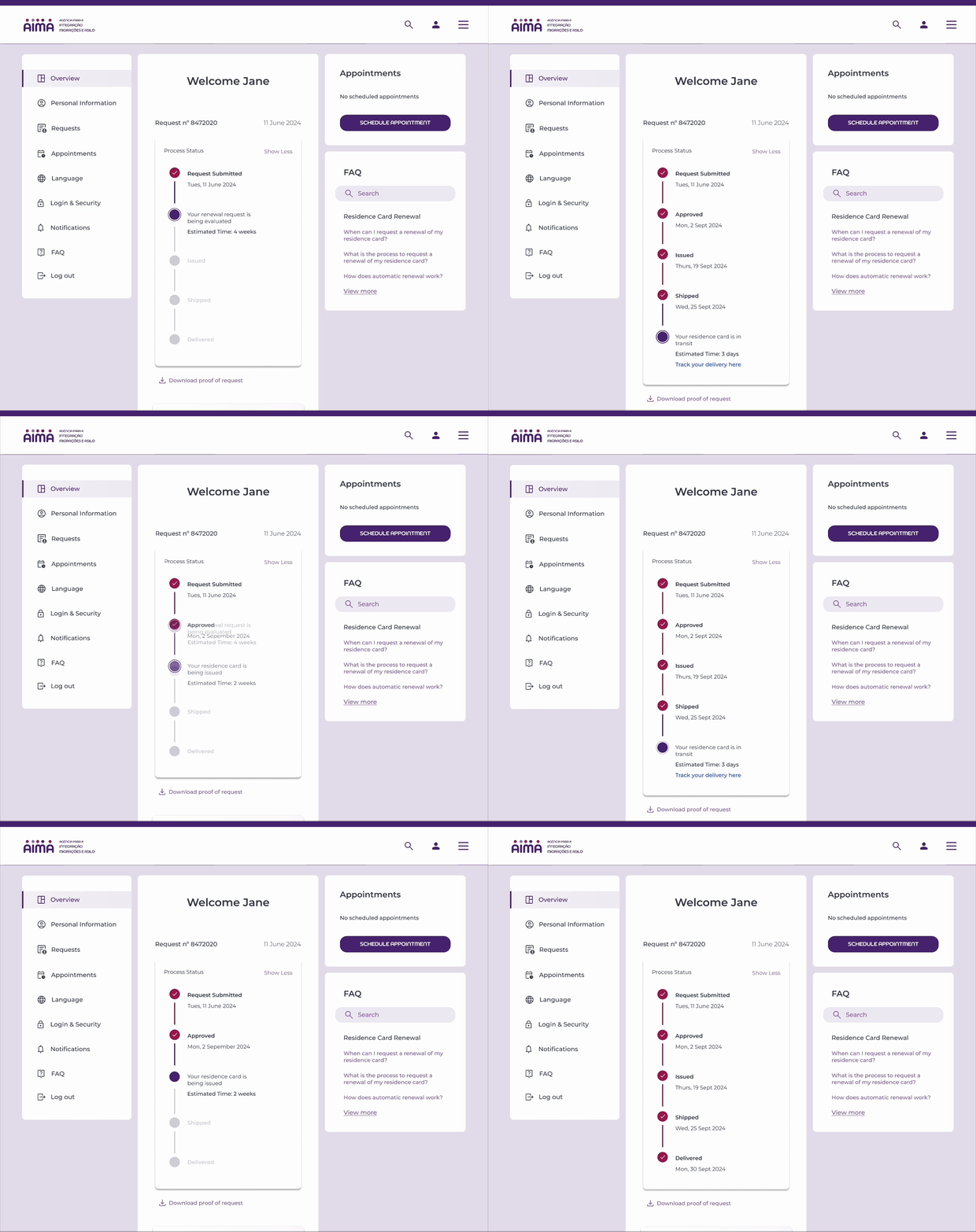
A progress tracker for document delivery solves for one of the biggest pain points for users mentioned - a lack of information about when their document would arrive at their home address. This step would in the process would provide reassurance during the wait, allowing users to follow progress and track the delivery of their document.
Impact & Validation
Success would be measured through:
Primary success metric: Percentage of eligible users completing their renewal entirely through the app without contacting AIMA—demonstrating that transparency and self-service goals were achieved;
User outcomes: Reduced time from eligibility to submission (target: under 30 minutes vs. current weeks/months of attempts), increased online completion rates, and improved ability to plan around known timelines (measured through follow-up surveys on whether users felt informed throughout the process);
Operational efficiency: Decreased support inquiries for status checks and process clarification, reduced call center volume, and increased capacity for staff to focus on application processing rather than answering repetitive questions.
Learnings
In production, P0 features would be phased across releases based on resource constraints—here, I prioritized a complete self-service flow to demonstrate how transparency and control work as an integrated system. Core UX principles guided the solution: maintaining user control and freedom through early renewal access, ensuring visibility of system status via real-time tracking, and preventing dead-ends by providing appointment booking alternatives for ineligible cases. Since the user account didn't exist, I designed it from the ground up including these core functions. The biggest challenge was designing without insight into AIMA's back-end processes and infrastructure, which would critically shape solution design in a real project.
Next Steps
I would present my research insights to AIMA stakeholders and their technical team to understand the reasoning and constraints behind their current user flow. This would be followed by co-designing an implementation roadmap and developing a complete service blueprint mapping front-stage touchpoints to back-stage processes and support systems. To move the user account solutions from concept to implementation, the next phase would include usability testing with 8-10 diverse users to validate core flows and identify friction points. Additionally, I would review AIMA's existing brand guidelines and component library to ensure visual consistency across products, while maintaining the focus on functionality and user flow.
Browse more projects:
-
![]()
Creating a clear positioning and service offering for Avalon’s Sales Advisory
Service design for Avalon Advisory
-
![]()
A branding brief that revealed a service design opportunity
Service design for Rita Santos Coaching
-
![]()
Avalon Advisory
Brand identity for a commercial consultancy working with early stage B2B SaaS companies
-
![]()
The Joy Spot
Brand identity for a space dedicated to female pleasure in Lisbon
-
![]()
Rita Santos Coaching
Brand identity and website design for a personal coach working with people navigating life and career transitions